Interview with Stephan West
There’s movement at the station. The Transfer Station that is. The movement is coming from the vision and leadership of Stephen West, Supervisor/Manager of Mt Alexander Shire’s two transfer stations in Castlemaine and Maldon. He is an environmentalist and animal lover and comes to the job after working in the private sector.
In the past 18 months he has managed to restructure the layout of the park, changed its operational procedures, modified equipment for greater efficiency and supervised the acceptance of new items we can now take to the tip for recycling.
And that’s just a start.
Textile Recycling
Recently the council decided to undertake the recycling of soft plastics and textiles in a 3 month trial. That trial has now ended with the council now deliberating on whether or not to proceed with full operations.
Each Australian consumes an average of 27 kilos of new clothing per year and disposes of an average of 2kilos of clothing to landfill each year. Australia is the second highest consumer of textiles per person in the world after the US.
Stephen explains that during the trial, many people took advantage of the opportunity to drop off their own unwanted clothing and according to him they loved the opportunity. Before this, 100% of textiles in the Shire, went to landfill. But over the past 3 months at Mt Alexander, more than 9 tonnes of textile waste has avoided this fate.
Soft Plastics Recycling
With the amount of soft plastics in our environment it is great to hear that the council has trialled this form of recycling as well. Approximately 538,000 tonnes of soft plastics are produced annually in Australia and only 6% is recycled. Approximately 300,000 tonnes are lost to landfill.
Most soft plastics are recycled into soft plastics again, such shopping bags or bread bags, but others are melted down and made into furniture, cat’s eyes ( retroreflective safety devices used in road marking) or road base. Some go back into fuel. Even if you might think some of these outcomes are short sighted, Stephen argues that they are still less harmful than digging up the raw materials such as petroleum from the ground and reprocessing them.
Values
Stephen is motivated by several values that have come with him from his previous job as a business owner and manager of a large steel manufacturing plant. When he had achieved what he had set out to do, he decided to sell at the end of Covid and began a new, perhaps more reflective time of his life.
He now lives and works by his beliefs that all businesses need to be socially aware and they need to care.
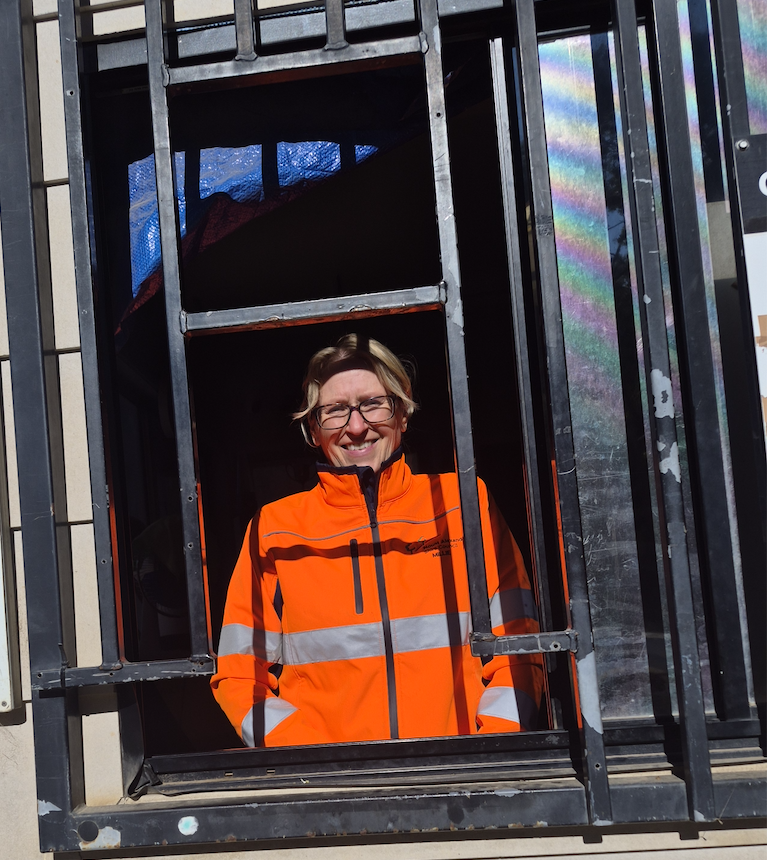
With this in mind it’s fundamental for him to have staff who are really good at customer relations, polite, respectful and committed. Anybody who has been to the transfer station will know that he has succeeded in this when you are greeted by a staff member with a wonderful smile at the window as you enter. It’s rare these days for a resident to complain, he says.
Text for This Block
Milly ready to greet residents at the Shire Transfer Station
Significantly recycling is at the forefront of his mind as he attempts to make sure as little as possible goes to landfill. Fees for landfill are expensive. To give you an idea, in Victoria one tonne of waste costs a station $300. But in the Shire the costs passed on to the public are the lowest in Victoria.
With close to 400 tonnes of rubbish deposited at the station per month, its exciting to talk with a man with such a vision, determined to to prevent as much going to landfill as possible and to make the staff want to come to work every day.
New Efficiency Drives
Determined to make the park as self sufficient as possible, he has cut down on costs by reusing what’s on site and selling what is saleable. As much as possible is done on site, thus saving on fuel. The station doesn’t aim to make a profit but it needs to break even.
As part of this vision, Paddy’s Market Shop is popular second-hand “tip shop” where nothing costs more than $15. It operates between 8.00am and 4.00pm every day. You can shop for pre-loved treasures, furniture, and recycled bicycles, or to drop off quality reusable items.
The green waste is another example of the new efficiency drive. We’ve always been able to dispose of it at the station, but now its sorted into one of three bays; One for leaves and soft grass, one for bigger logs which are given to the public for free and one for clean clippings they are free of weeds and seeds.
There is a if fee for this service depending on the weight of your load.
What can you take to the station for FREE
While textiles and soft plastics are now on hold till a decision is made by council there are myriad things that are recyclable and can be prevented from going to landfill.
- Glass is separated from the local recycle bins and sent to ASQ or put back into general recycling or are used for road base. The glass doesn’t have to be clean. The only thing they won’t accept is window pane glass.
- Cardboard that used to go in General Recycling, now is separated out by the staff. This limits contamination and everything is inspected before going off site. Cardboard covered in paint is not accepted because it’s more labour intensive.
- Aluminium or steel – and goes into steel bins which are sent to a recycler, pressed and sold overseas. Often they are turned into more steel, avoiding the 10 step process of digging it out of the ground and processing it. Recycling into more steel is a two step process only.
- All Ewaste – up to 80% of a computer is stripped down and recycled.
- Smaller Ewaste like calculators, can be used again, even the screws and buttons are sent to recycler.
- Motor oil and oil containers.
- All globes.
- Batteries of any size can be dropped off.
- Bagmuster, woven feed lot bags can now be dropped off for recycling.
What you pay for
- Asbestos. The station accepts it and it the Shire subsides the cost to send it to a special asbestos landfill in Bulla
- Mattresses are recycled at the cost of $29.95. Once again a special mattress recycler takes them. There is a cost to the station for this.
- Fridges and air conditioners are degassed and recycled. The charge is $1O per unit.
- Printers entail a minimal cost to drop in.
- Chemical containers if rinsed can be dropped off for a fee and they go to a chemical waster recycler.
- Green waste
FOGO – Food & Organic Waste
FOGO is another subject under discussion by the Shire. The manner and method of collecting food and green waste are yet to be determined.
FUTURE PLANS IN THE PIPELINE
- Stephen is always on the lookout for new items to recycle
- Styrofoam is in his sights. It can be broken down and made into more of the same or insulation blocks.
- Plaster Boards which can go to making road base.
- Solar Panels and Lithium Batteries which can be reused.
Stephen’s very active imagination is working on calculating what to do next and how to manage these new options. Having seen what he has already done, MANZWG is confident that the current available recycling options are very likely to be expanded.
Article – Fran Gleeson
###