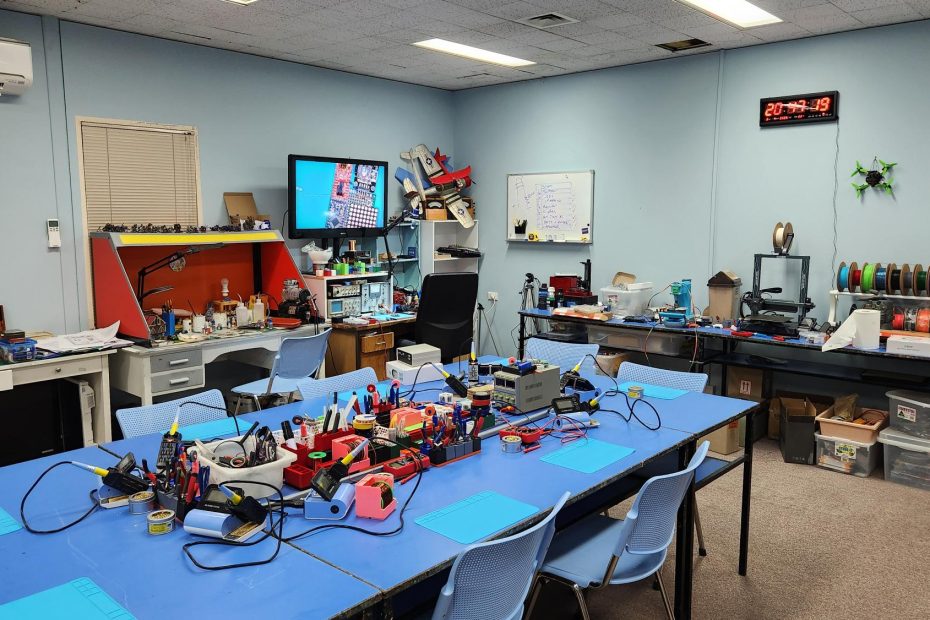
Each week, a group of upper primary and lower secondary students eagerly gather for a unique after-school class in the old hospital in Halford Street Castlemaine. Their teacher, Dan Nixon, isn’t just teaching them how things work—he’s teaching them how to fail.
Dan’s life experiences have instilled in him a valuable principle that he now shares with his students: that understanding how things are designed and built, and learning through trial and error, makes for more engaged and resourceful individuals. His students explore the mechanics of electronics, gaining an appreciation for the materials and design behind everyday objects—like a simple watch—that might otherwise be taken for granted.
In his classes, assembly is a mystery. Students aren’t handed instructions; instead, they must figure it out themselves. “They fail and fail again,” Dan says. But that’s the point—failure is part of learning. Over ten weeks, they may only experience six moments of success. Yet, incredibly, they keep coming back for more.
Dan embodies the lessons he teaches. Born in the 1980s, he grew up in Kerang on a mixed farm raising cattle, sheep, and later dairy cows. His family was extremely poor, so when something broke—whether a pump or a machine—buying a replacement wasn’t an option. They had to fix things with what was available, repurposing materials and seeking advice from neighbours. Recycling and ingenuity weren’t just ideals; they were a way of life.
The region had the highest salinity rates in the country, which made water management a constant challenge. One day, musician and environmental activist Peter Garrett visited their town to raise awareness about climate change and poor farming practices. However, upon speaking with the locals, he quickly realised they were already well aware of the land’s fragility. They had taken action, planting trees and saltbushes to combat salinity. Community groups like the Scouts, Rotary, and Lions Club all played a role in these efforts.
Dan still recalls the highlight of that day—Peter Garrett bought each child a can of Coke, a rare and special treat.
When Dan moved to the city as an adult, he was astonished by how few people knew how to fix things. Suddenly, his skills made him seem like a superhero. But back home, everyone—boys and girls, men and women—could jump-start a car, siphon petrol, drive a tractor, load and unload trucks, and repair machinery.
While his father and brothers excelled in welding, woodworking, and construction, Dan carved out his own expertise in auto-electrical work. Fascinated by cars, motorbikes, and tractors, he quickly became proficient, teaching himself using children’s books on electronics. He longed for an Electronic Experimenter Kit but couldn’t afford one. Instead, he learned through hands-on trial and error. His persistence paid off—auto electricians were highly respected in the country, considered as essential as doctors.
Dan eventually set up his electronics classes in a room at the old hospital after his son Frankie and his friends began working on projects at home. As more children became interested, his home couldn’t accommodate them all.
Now, in this dedicated space, students explore the fundamentals of electric motors, work with 3D printers, experiment with compasses and electromagnets, and build floating miniature compasses. They construct watches, learn to code, discover how LEDs function, and master the art of epoxy resin. They even created a breadboard—an essential tool for designing and testing circuits—allowing them to experiment with electrical components freely.
“It’s not so much about the things they make,” Dan explains. “It’s about the process and the journey. These children are going to have way more respect for what we consume. And you can get 8 times more life out of every product if you can fix it”